What Does a High Bilirubin Reading Mean
Bilirubin blood test
Total bilirubin - blood; Unconjugated bilirubin - blood; Indirect bilirubin - blood; Conjugated bilirubin - blood; Direct bilirubin - blood; Jaundice - bilirubin claret test; Hyperbilirubinemia - bilirubin blood exam
The bilirubin claret test measures the level of bilirubin in the claret. Bilirubin is a yellowish pigment found in bile, a fluid made past the liver.
Bilirubin can as well be measured with a urine test.
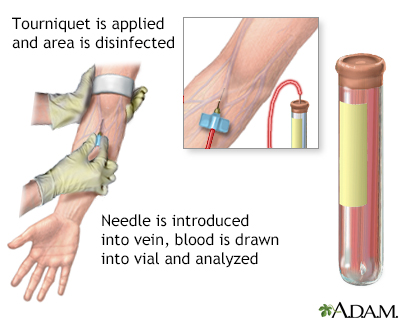
Blood is drawn from a vein (venipuncture), usually from the inside of the elbow or the back of the hand. A needle is inserted into the vein, and the blood is collected in an air-tight vial or a syringe. Preparation may vary depending on the specific test.
How the Test is Performed
A claret sample is needed.
How to Ready for the Test
You should not consume or drink for at least iv hours before the test. Your wellness care provider may instruct you to stop taking medicines that affect the test.
Many drugs may change the bilirubin level in your blood. Make sure your provider knows which medicines you are taking.
How the Test will Feel
When the needle is inserted to draw blood, some people feel moderate pain. Others experience only a prick or stinging. Later on, at that place may be some throbbing or a slight bruise. This soon goes abroad.
Why the Test is Performed
A minor amount of older red blood cells are replaced by new blood cells every twenty-four hour period. Bilirubin is left in the claret after these older claret cells are removed. The liver helps break downwardly bilirubin so that it can be removed from the body in the stool.
A level of bilirubin in the claret of ii.0 mg/dL can create jaundice. Jaundice is a yellow color in the skin, mucus membranes, or eyes.
Jaundice is the most mutual reason to check bilirubin level. The examination will likely be ordered when:
- The provider is concerned about a newborn's jaundice (most newborns accept some jaundice)
- Jaundice develops in older infants, children, and adults
A bilirubin examination is also ordered when the provider suspects a person has liver or gallbladder problems.
Normal Results
It is normal to have some bilirubin in the blood. A normal level is:
- Direct (too chosen conjugated) bilirubin: less than 0.iii mg/dL (less than 5.one µmol/L)
- Full bilirubin: 0.i to ane.2 mg/dL (1.71 to 20.5 µmol/L)
Normal value ranges may vary slightly amid different laboratories. Some labs utilise different measurements or may test different samples. Talk to your provider about the meaning of your specific test results.
What Abnormal Results Mean
In newborns, bilirubin level is higher for the first few days of life. Your child's provider must consider the post-obit when deciding whether your baby'southward bilirubin level is too loftier:
- How fast the level has been ascension
- Whether the baby was built-in early
- The baby'due south historic period
Jaundice can also occur when more scarlet claret cells than normal are broken down. This tin can be caused past:
- A blood disorder called erythroblastosis fetalis
- A ruby-red blood cell disorder called hemolytic anemia
- Transfusion reaction in which reddish blood cells that were given in a transfusion are destroyed past the person'south immune organization
The following liver problems may too crusade jaundice or a high bilirubin level:
- Scarring of the liver (cirrhosis)
- Swollen and inflamed liver (hepatitis)
- Other liver disease
- Disorder in which bilirubin is not processed normally by the liver (Gilbert disease)
The following bug with gallbladder or bile ducts may cause college bilirubin levels:
- Abnormal narrowing of the mutual bile duct (biliary stricture)
- Cancer of the pancreas or gallbladder
- Gallstones
Risks
There is lilliputian risk involved with having your blood taken. Veins vary in size from 1 person to some other and from one side of the torso to the other. Obtaining a blood sample from some people may exist more than difficult than from others.
Risks associated with having blood drawn are slight, only may include:
- Excessive haemorrhage
- Fainting or feeling silly
- Multiple punctures to locate veins
- Hematoma (blood collecting under the peel)
- Infection (a slight take a chance any time the skin is broken)
References
Chernecky CC, Berger BJ. Bilirubin (total, direct [conjugated] and indirect [unconjugated]) - serum. In: Chernecky CC, Berger BJ, eds. Laboratory Tests and Diagnostic Procedures. 6th ed. St Louis, MO: Elsevier Saunders; 2013:196-198.
Daniels L, Khalili M, Goldstein E, Bluth MH, Bowne WB, Pincus MR. Evaluation of liver office. In: McPherson RA, Pincus MR, eds. Henry's Clinical Diagnosis and Management by Laboratory Methods. 24th ed. Philadelphia, PA: Elsevier; 2022:chap 22.
Pratt DS. Liver chemistry and part tests. In: Feldman 1000, Friedman LS, Brandt LJ, eds. Sleisenger and Fordtran's Gastrointestinal and Liver Disease: Pathophysiology/Diagnosis/Direction. 11th ed. Philadelphia, PA: Elsevier; 2021:chap 73.
Version Info
Last reviewed on: 1/24/2021
Reviewed past: David C. Dugdale, III, MD, Professor of Medicine, Division of General Medicine, Department of Medicine, University of Washington School of Medicine, Seattle, WA. Also reviewed past David Zieve, MD, MHA, Medical Director, Brenda Conaway, Editorial Director, and the A.D.A.One thousand. Editorial team.

Source: https://www.mountsinai.org/health-library/tests/bilirubin-blood-test

Post a Comment for "What Does a High Bilirubin Reading Mean"